Category: Stop-motion Animation

  • Animated Documentary

    Industry Insights Unit 2

    Talking to animator Erica Russell about her recent animated coproduction COME (2025)
    COME (2025) Opening Credit from Rhode Island International Film Festival

    Using animation within documentary is a bit of an experiment. 

    Counter to the pedagogical nature of a documentary, a filmic exploration and fact sharing conversation into and around a subject of choice, the emotive use of animation (distinct from infographics) can add a dimension of understanding on a deeper level. In its distance from reality, animation can reach out emotionally, inviting creative thinking and subliminal connection. 

    Done well, it is less an addition, more an integration and facilitation. Animation is boundless in its ability to show or depict anything anyhow. It can shine a light into topics which are otherwise intangible, conceptual or sensation rather than object based. To me this seems like a perfect marriage. A balance of documented fact and conjecture with a visualisation of ideas and emotions. 

    Within a documentary, imaginative animation can take abstract and make it real.  

    In this blog post I wish to explore and align the professional use of animation within the film COME (2025) a documentary about the female orgasm, directed by Bronwen Parker-Rhodes and animated by Erica Russell, with my own experience in creating the art documentary Making Umwelt (2026). 

    I met up with Erica for a chat. 

    Erica Russell is an award-winning animator living in North London. She is most famous for her abstract animations Triangle (1994) and Feet of Song (1988). Working in stop motion on paper with paint, Erica is less a traditionalist more a hybrid. Her style is unique, expressive, painterly and exquisite. Her passion is movement, flow and the human form. 
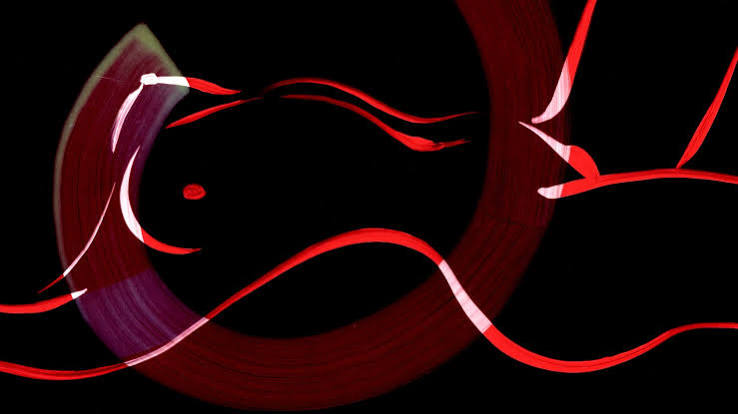
    Still from COME (2025) Erica Russell

    Working on COME, therefore, was the perfect match. Not a subject that can be illustrated in a traditional form, Erica’s animations are made to conjure a visual sense of what it feels like to experience an orgasm – feelings, emotions, sensation and touch. They are suggestive, abstract and fluid. Images to facilitate our understanding of the interviewee’s words. Effective but nonprescriptive. 

    The creative dialogue between Bronwen Parker-Rhodes and Erica was a series of exchanges. Erica’s process is old school and non-digital, scanning individual painting for each sequence. With these, BPR would create a line-test and a conversation of brainstorming, refinements and reviews ensued. Erica explained

    “Hand drawn animation naturally builds in accidental marks and irregularities like real body motion, something which digital animation cannot replicate” 

    “We wanted to create a fluidity in our interpretation, not a literal illustration of the interviewees” 
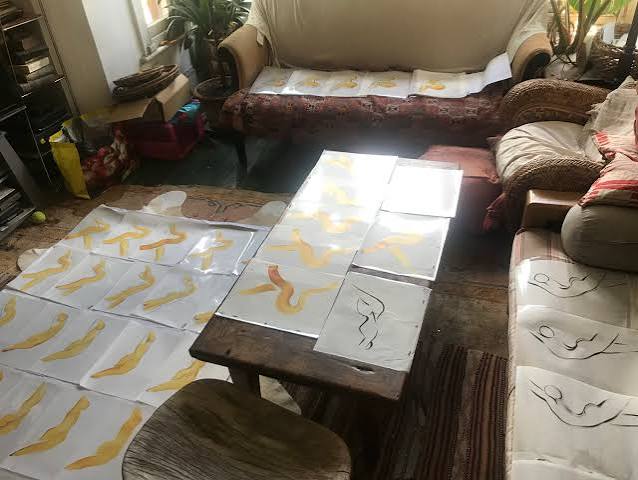
    Process artwork for COME (2025) Erica Russell

    Loops of movement allowed a rhythmic freedom within the work to expand and contrast to fit the required edit. The flow was essential in both the animated and the narrative film. As Erica explains “lots of roughs were reworked or eliminated. It had to feel right”.  (Russell, quoted in MacKinnon, 2025)

    This intuition is what interests me the most. 

    The creative process in making an animated documentary is a fine balancing act of storytelling. Used well, as in COME, the moving graphics can illuminate and inspire a plethora of possibilities. A gateway to multifaceted comprehensions. The power of suggestion possible in animation, taking abstracted form and refining its appearance is an invitation to feel. Non lineal. Non prescriptive. As an animator, I love this balancing act. 
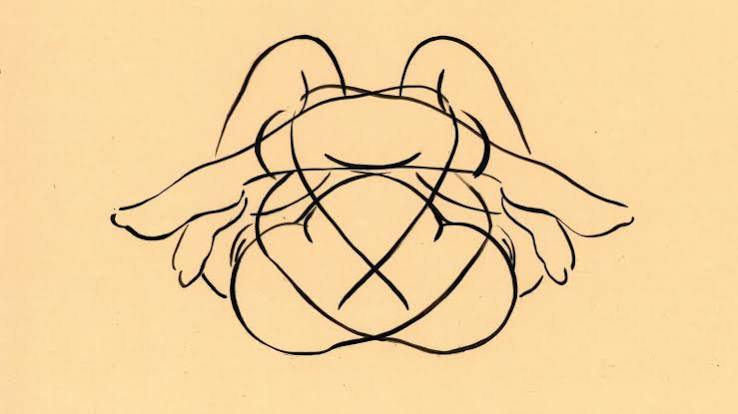
    Still from COME (2025) Erica Russell

    “Animation has the potential to be much more than just illustration” Erica explains.

    My connective touchstone with talking to Erica is Honesty. Bronwen Parker-Rhodes and Erica decided on a binary film of wide angled interviews and animation. Simple. No distractive camera moves, cut-aways or the nailing to a specific time or place, this film was bare bones and in my opinion all the better for it.  

    The real challenge Erica told me, was in the edit. 
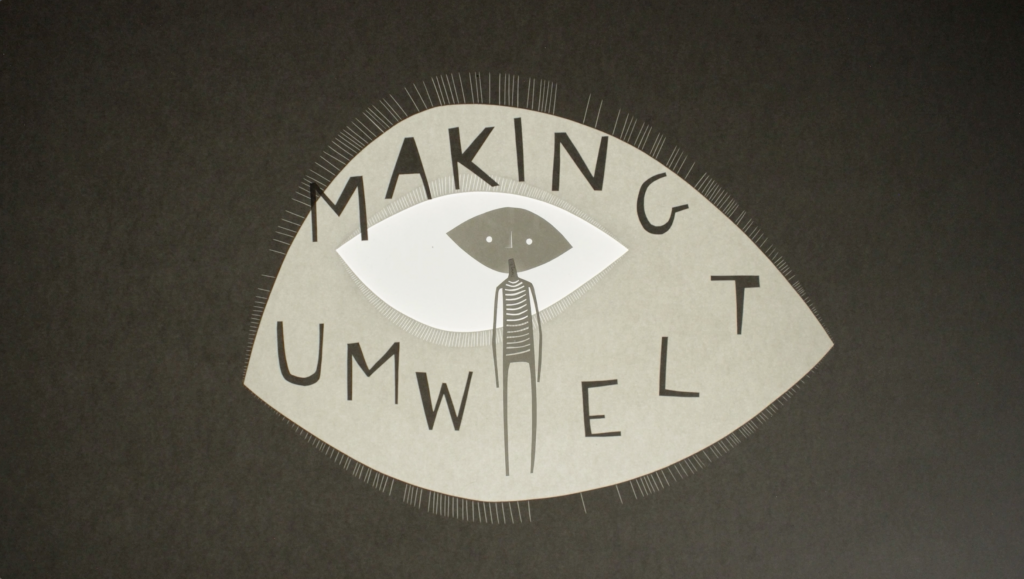
    Opening Credit animation Making Umwelt (2026) Imogen Harvey-Lewis

    My solo experience in making Making Umwelt, as both director and animator has been creative from start to finish. The film plots my ideas, motivations and techniques behind a short-animated film Umwelt commissioned for LIAF 2026. Animated content enabled me to present concepts, keeping the aesthetic aligned and cohesive.  

    A documentary contains a range of information but is fundamentally a creative piece itself. It would be easy to be distracted down a series of illustrative rabbit holes and end up with a confusion of disparate soundbites. To attain a clarity in visual language requires an honesty, and that means speaking your own visual language, consistently. With each clip the question “What am I trying to say?” 

    For me too, the surprising creativity came in the edit. As Erica explained “turning the edit into a very intricate jigsaw puzzle”, the process is almost sculptural but one where infinite variation each tell a slightly different story. 

    Holding the threads of intuition and a detailed game plan posed a tantalising challenge. 
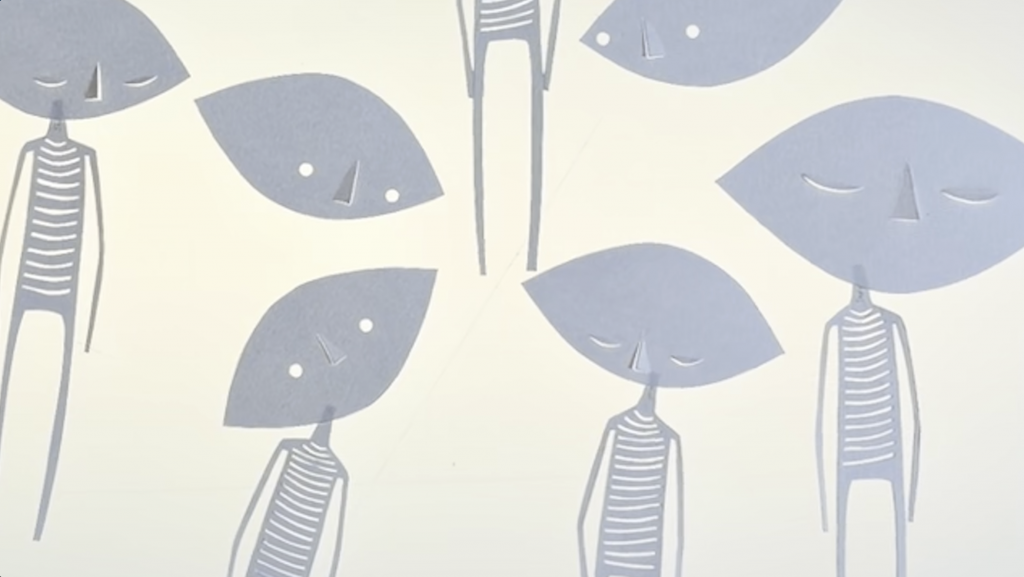
    Making Umwelt (2026) Imogen Harvey-Lewis

    Using Adobe Premier Pro, the editing process requires method, oversight and attention to detail. Creating great content is essential, but shaping it, directing it, layering up a montage of clips and keeping to a timescale was a whole other level. Keeping all variables alive and ready was addictive. As with COME, many of the animated elements in MU where conceived as immotive space holders, to intrigue and to illuminate the spoken word. 
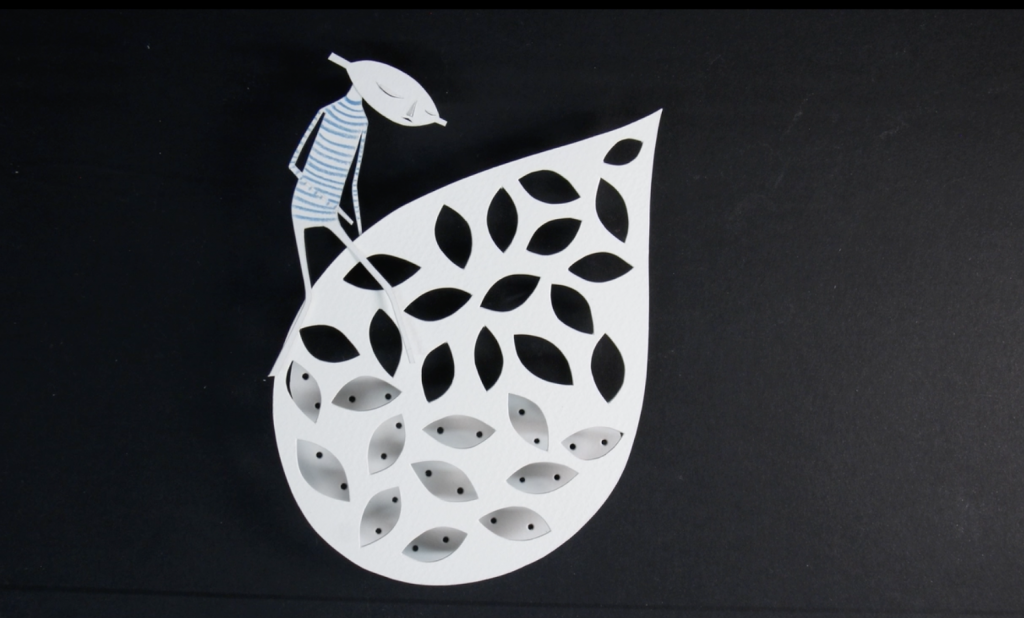
    Making Umwelt (2026) Imogen Harvey-Lewis

    Erica works from her Highgate studio. Her space is eclectic and arty. She works primarily with paint on paper and cells. Her custom rostrum is enormous and her coffee is good. 

    We talk about animation, art, painting and film. We talk about how the world of commercial animation is changing and the insidious gloaming of AI. 

    I learned that to be successful in animated documentary you must follow your head and your heart. Learn your craft and optimise your dexterity to the best of your ability. Enjoying the edit and leave time for this. Respect yourself and your work, be clear on your intent and above all be honest. 

    References

    COME (2025)Directed by Parker-Rhodes, B. https://www.youtube.com/watch?v=Xp0wRYCWhFU

    Feet of Song (1988). Directed by Russell,E

    Triangle (1994). Directed by Russell, E

    Bronwen Parker-Rhodes and Erica Russell (2025). ‘How Do You Animate an Orgasm?’ Interviewed by Sarah Smith Director’s Notes web interview 9th January 2025. https://directorsnotes.com/2025/09/01/bronwen-parker-rhodes-come/

    Bronwen Parker-Rhodes and Erica Russell (2025). ‘Come:An Interview with Bronwen Parker-Rhodes and Erica Russell’ Interviewed by C.MacKinnon, Exploring Animated Documentary, 9th June, 2025. https://animateddocs.com/2025/09/06/come-an-interview-with-bronwen-parker-rhodes-erica-russell/
  • Simulated Work Experience

    MACA 2026

    Stop-motion Cat Painter

    I am working with Director Lucia Yu on her film Cat Painter. 

    It is a collaborative animation project working in 3D puppet stop-motion and tells the story of a down on his luck artist, whose paintings come to life and become a haunting obsession.There are 2 characters: the Cat Painter and his muse, the Fish. 

    I am joining the work schedule in its early stages. The animatic is made; character design established; set design mapped out and puppet build semi complete. A perfect example of work in progress. 

    Lucia is organised, yet open to discussion and design suggestion.  Stop motion puppet animation is a new venture for her, which enables me to observe her process and challenges in real time, which is an opportunity to learn together. My primary role is to support in the making of props and scenery. My secondary role is to be an objective sounding board for Lucia, to be available to chat and discuss options during this initial decision heavy part of the preparatory process.

    First job was to watch the Animatic.

    ​animatic 1.mov

    This gave me an essential overview and understanding of Lucia’s vision for the story line, the action involved, pace and location changes.

    Pre-shooting, puppet stop-motion is very top heavy. A large proportion of the work is in the preparation and the build. Setting everything up prior to shooting the first frame. 

    Cat Painter: early set mark out. Lucia Yu, 2026.

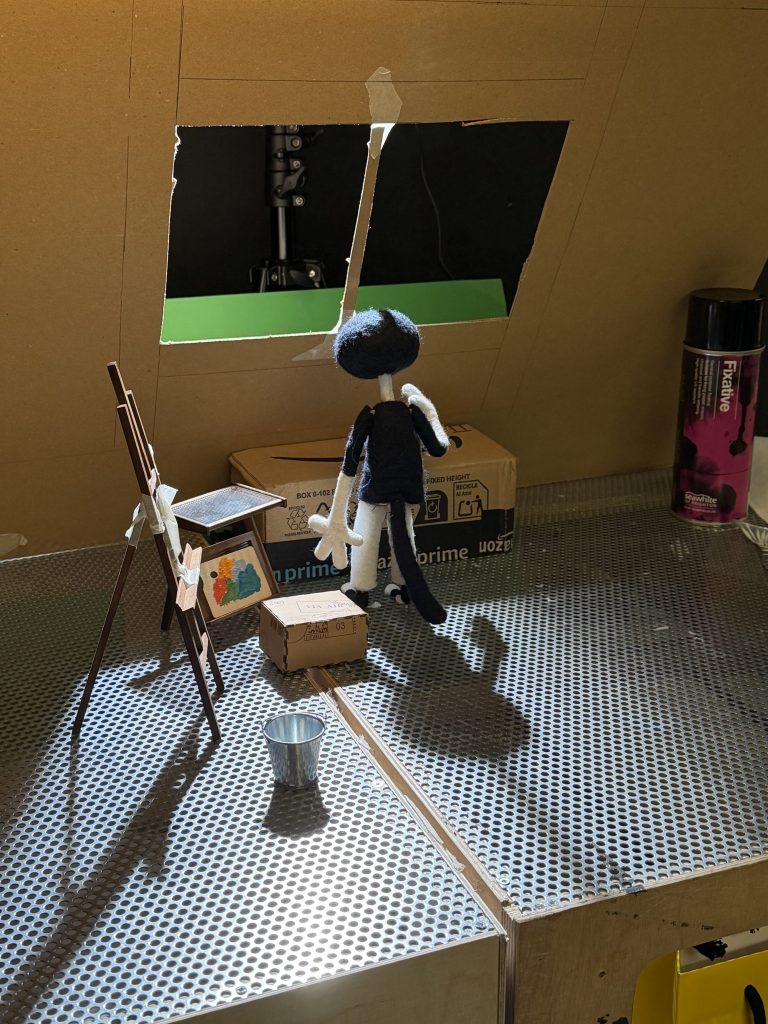
    Painter Cat is set in an artist’s studio. Lucia’s drawn rendition of the set is a detailed reference and carefully planned to accommodate her animatic. Her build concept leans towards realism, with a blend of intricately handmade wooden furniture, and sourced dolls-house miniature props. To achieve this realistic aesthetic, a great deal of meticulous hand crafting is required. This takes time and adds pressure to the schedule; however, it is a choice and one which hopefully will pay off in the appearance of the final shoot. 

    Painting the wooden floor test piece – Cat Painter. Lucia Yu and Imogen Harvey-Lewis 2026

    In contrast, the main Cat character is anamorphic, with a cartoon stylistic that allows for a wide-ranging set of movements and character traits falling somewhere between cat and human. A common suspension in animated reality. 

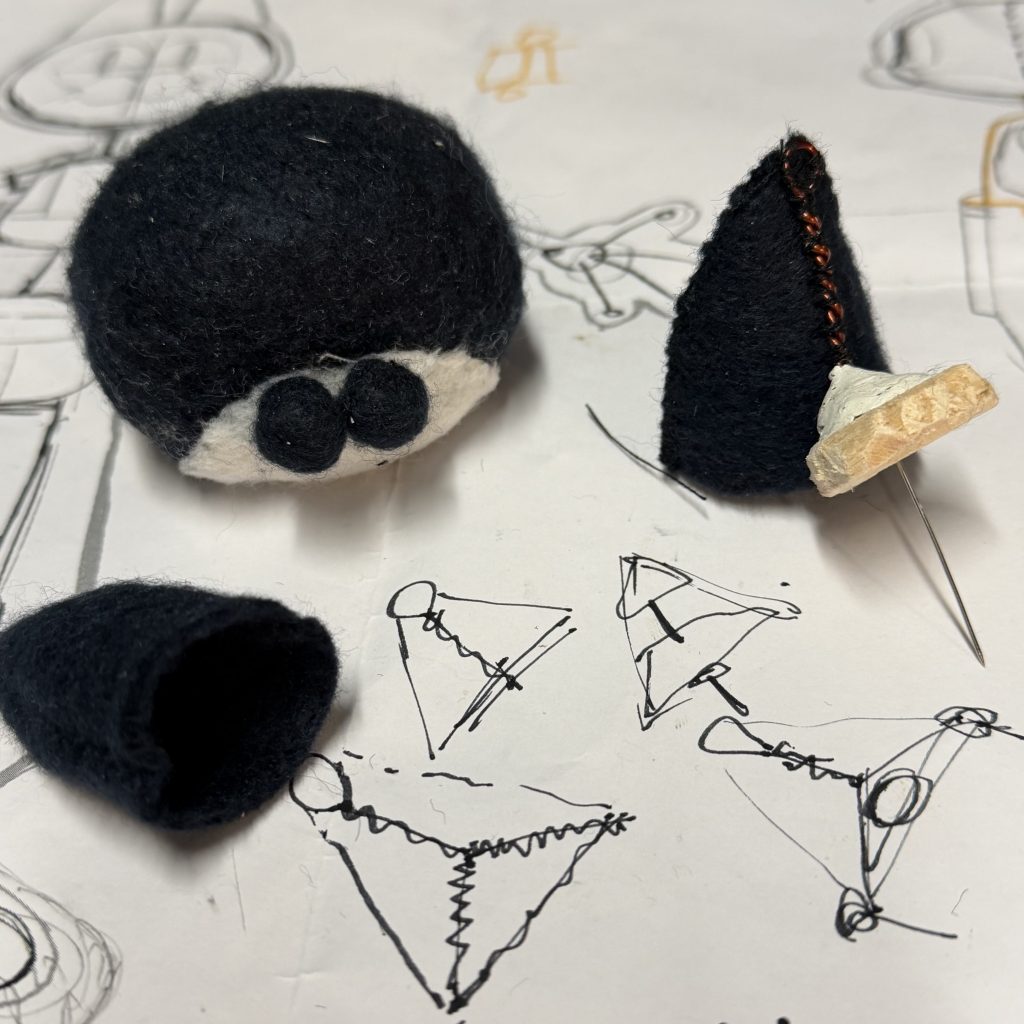
    Felt Ears for the main character – felt, wire, balsa wood. Lucia Yu and Imogen Harvey-Lewis, 2026

    Making a fully articulated 3D puppet is also a slow and precise process. Far more complex than my previous attempts, Lucia’s puppet of wood, wire and felt has interchangeable and removable arms, feet, head, ears and tail. This is to guard against breakages (a major setback to a one-piece puppet) but makes for a more fragile figure in the build, as pieces keep detaching. Hopefully worth it in the long run.  As an example, the photo above shows a detail of the workings and construction of the Ears. Everything must articulate, so the process is a 3 piece felt cut and sewn; a wooden base cut and shaped to fit the head contour; a wire spine twisted and attached to felt and wood bases; a pin pushed through the wooden base so that the ears can be attached and repositioned where necessary.

    I have been tasked with experimenting with materials for the fish and how it might be realised in animation. 

    The fish transforms from painted canvas to real life, escaping the confines of the easel and leads the cat on a hunger induced romp around the studio and into a surreal escapism. Consequently, it has quite a bit of action and needs to move well.  

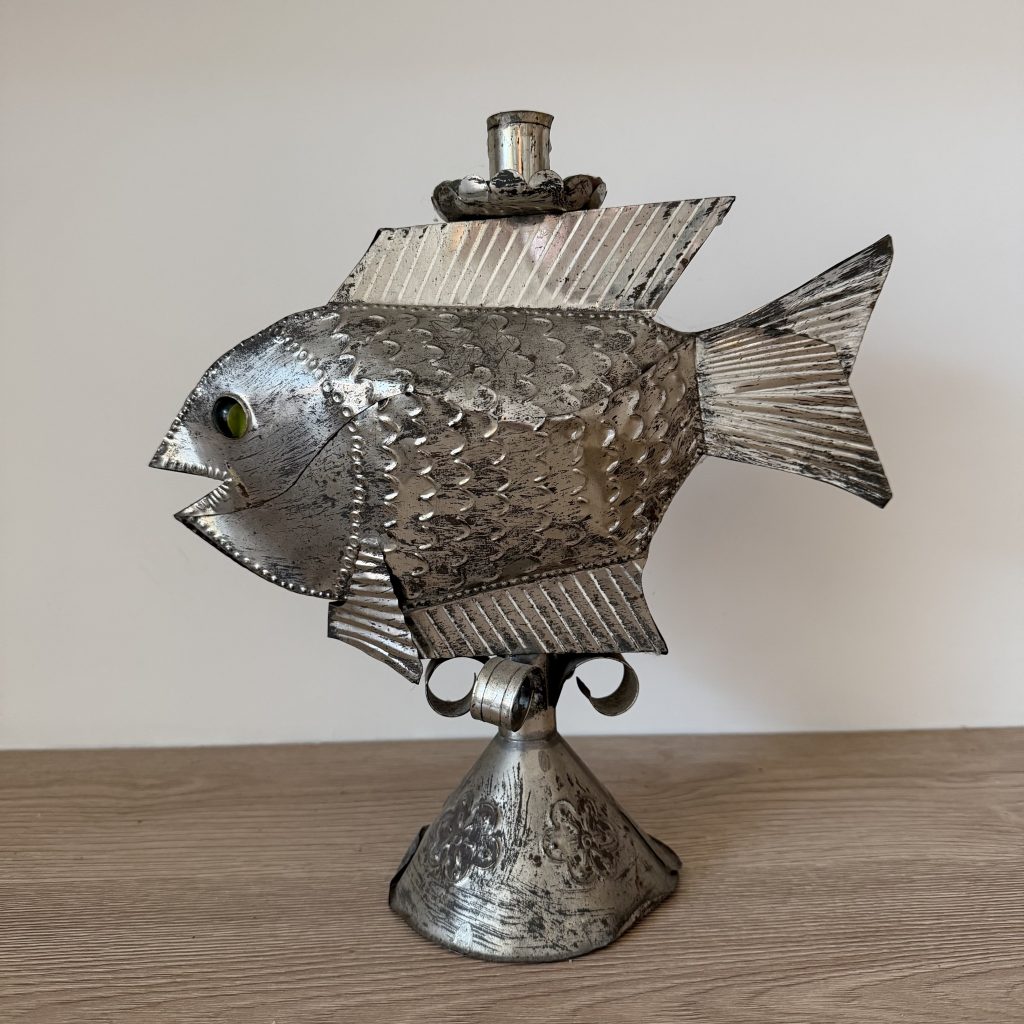
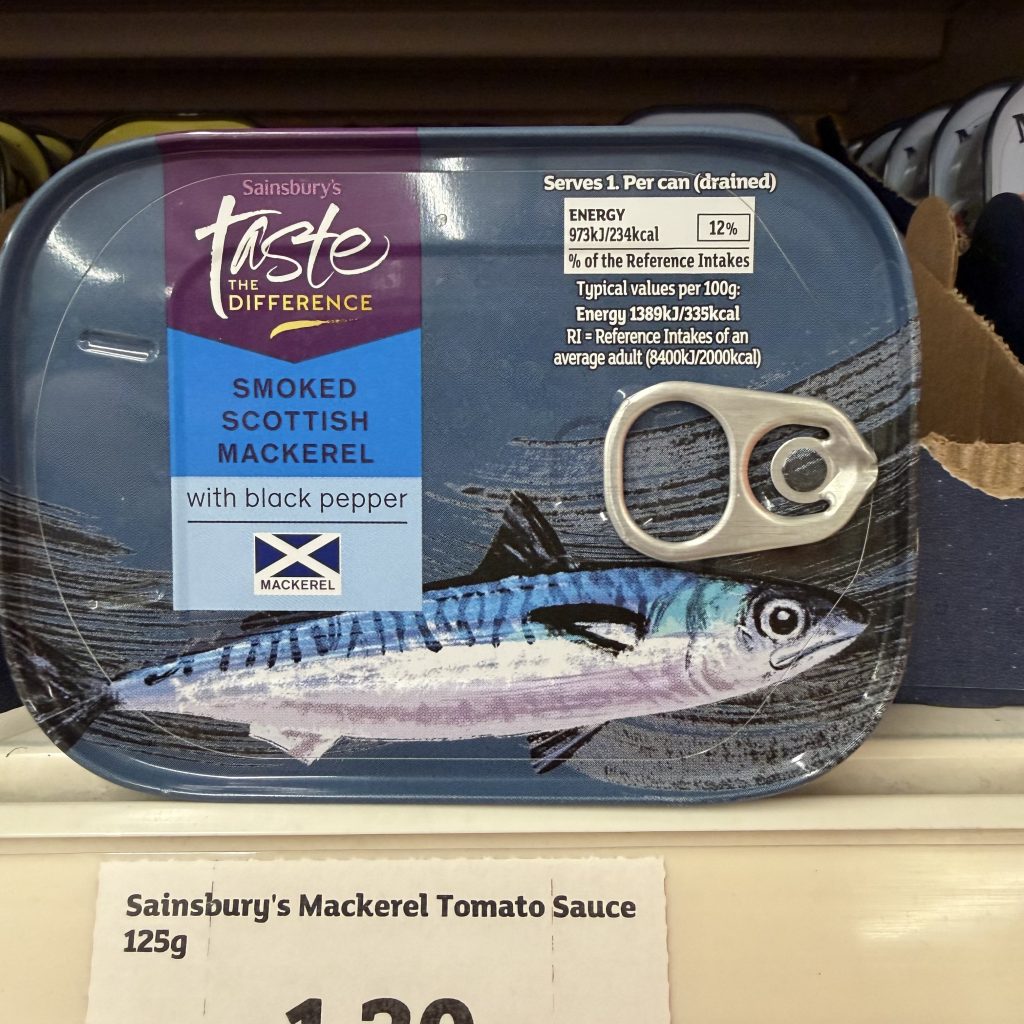
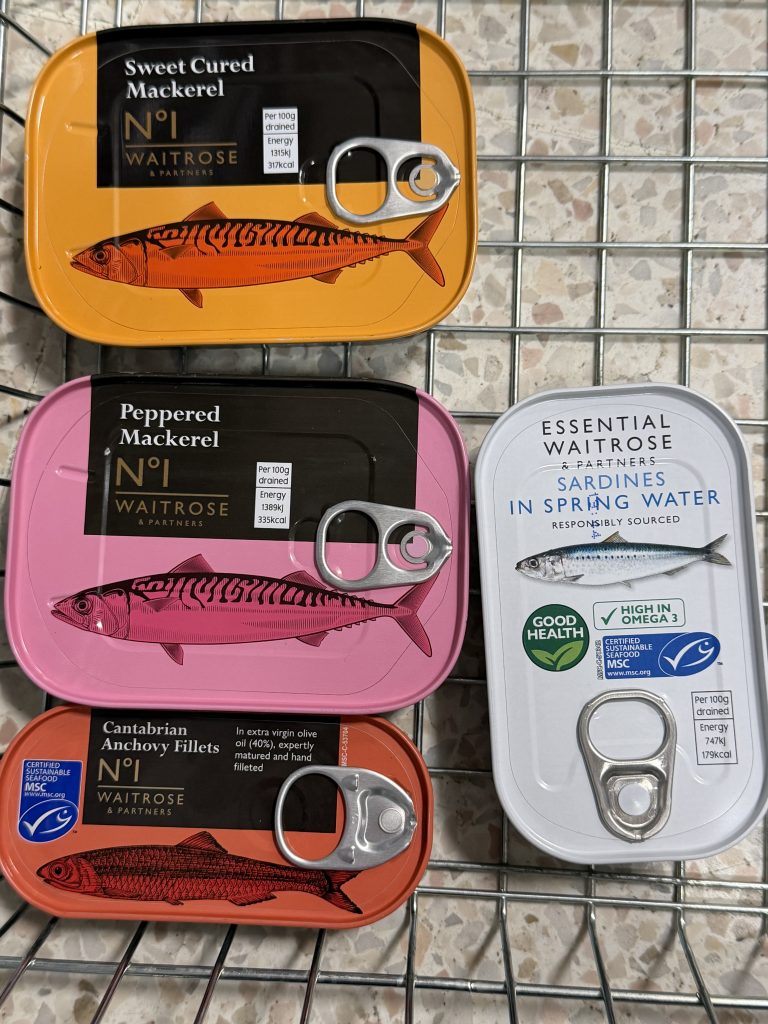
    Looking into fish inspired options and I have been drawn to the notion of cutting out fish from sheet metal. Ideally from an actual tin of fish and perhaps using abstracts from the existing packaging graphics to inform the design. This not only ticks the recycling box and is metallic and shiny like fish skin, but links nicely with the story – the hungry cat finishing his last tin of fish, the fish character as food. 

    Mexican tin fish sculpture (own collection) Ref.
    Fish tin – Sainsburys. Ref.
    Fish tin graphics – Waitrose. Ref.

    I went in search of fish graphics, patterns and textures.

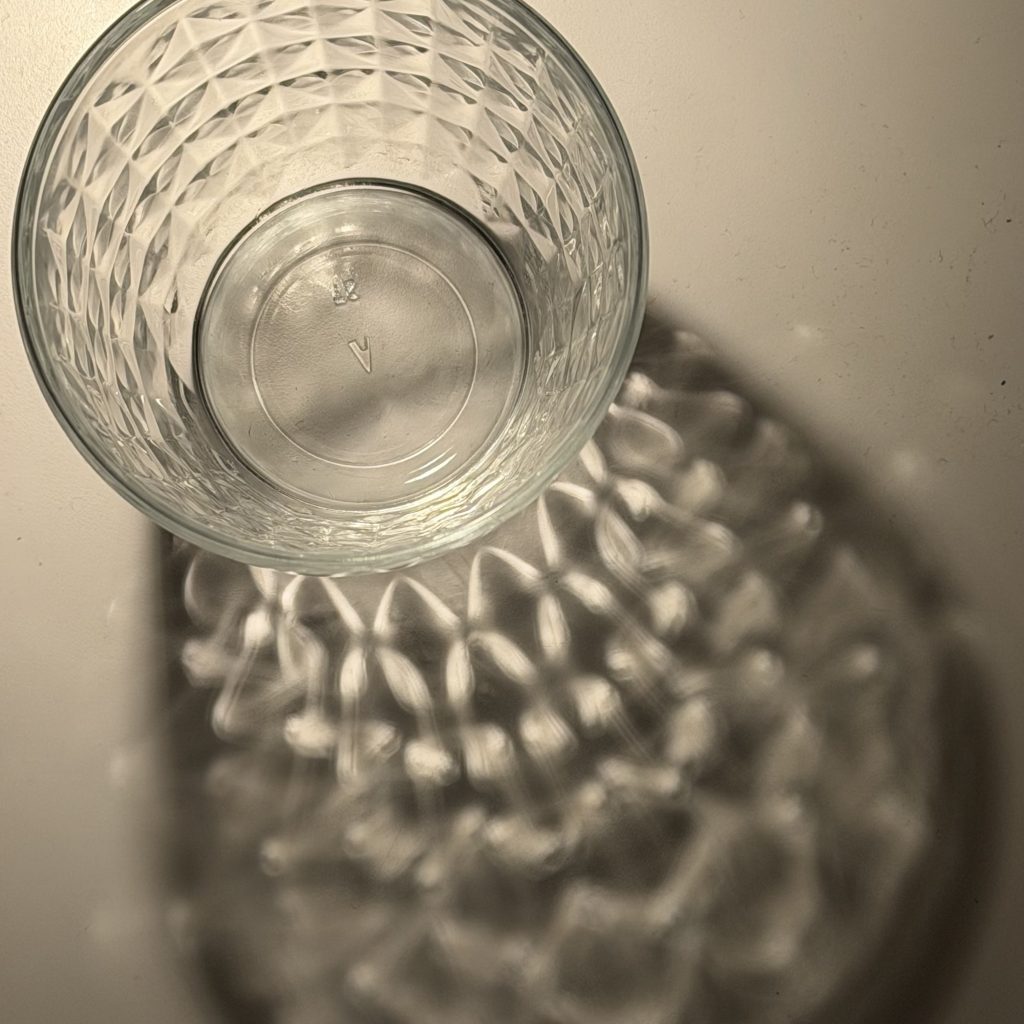
    Light and shadow pattern from a glass as reference for fish skin
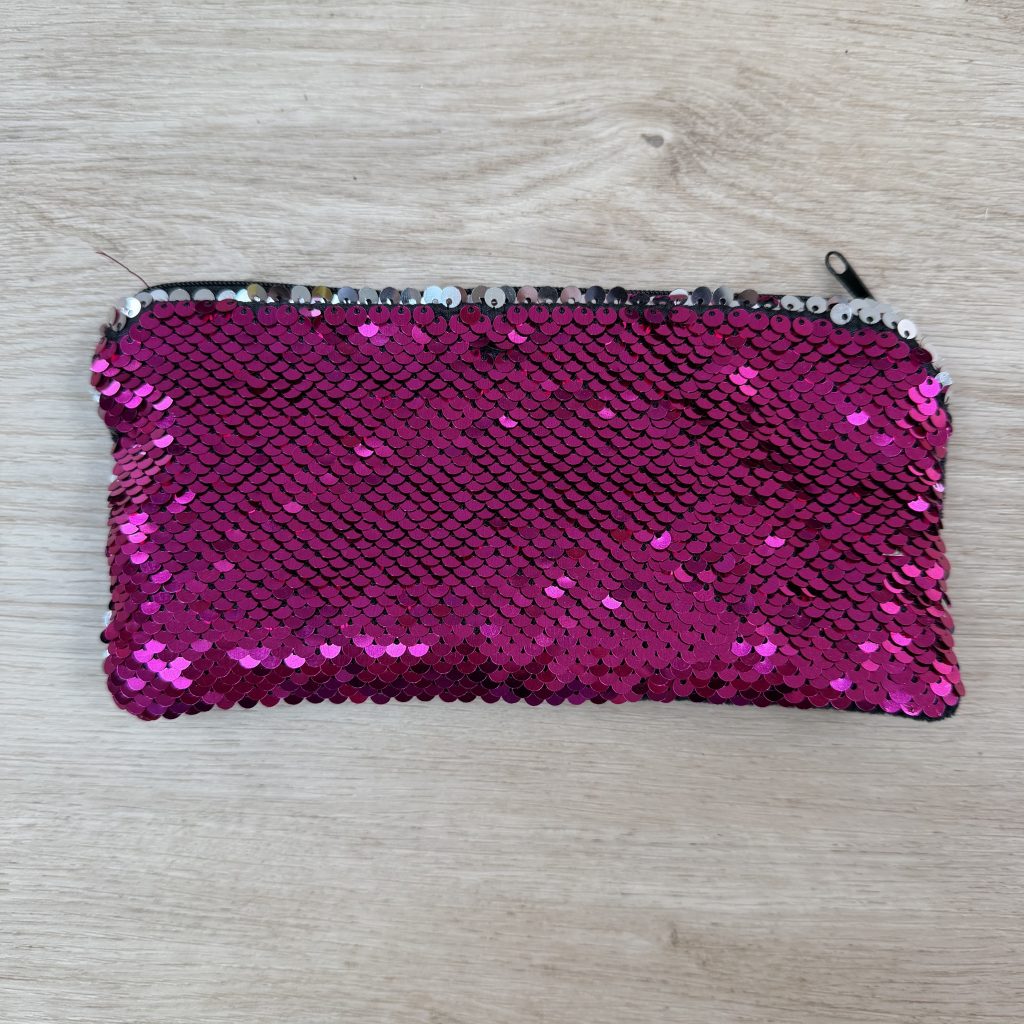
    Sequin fabric as reference for fish skin
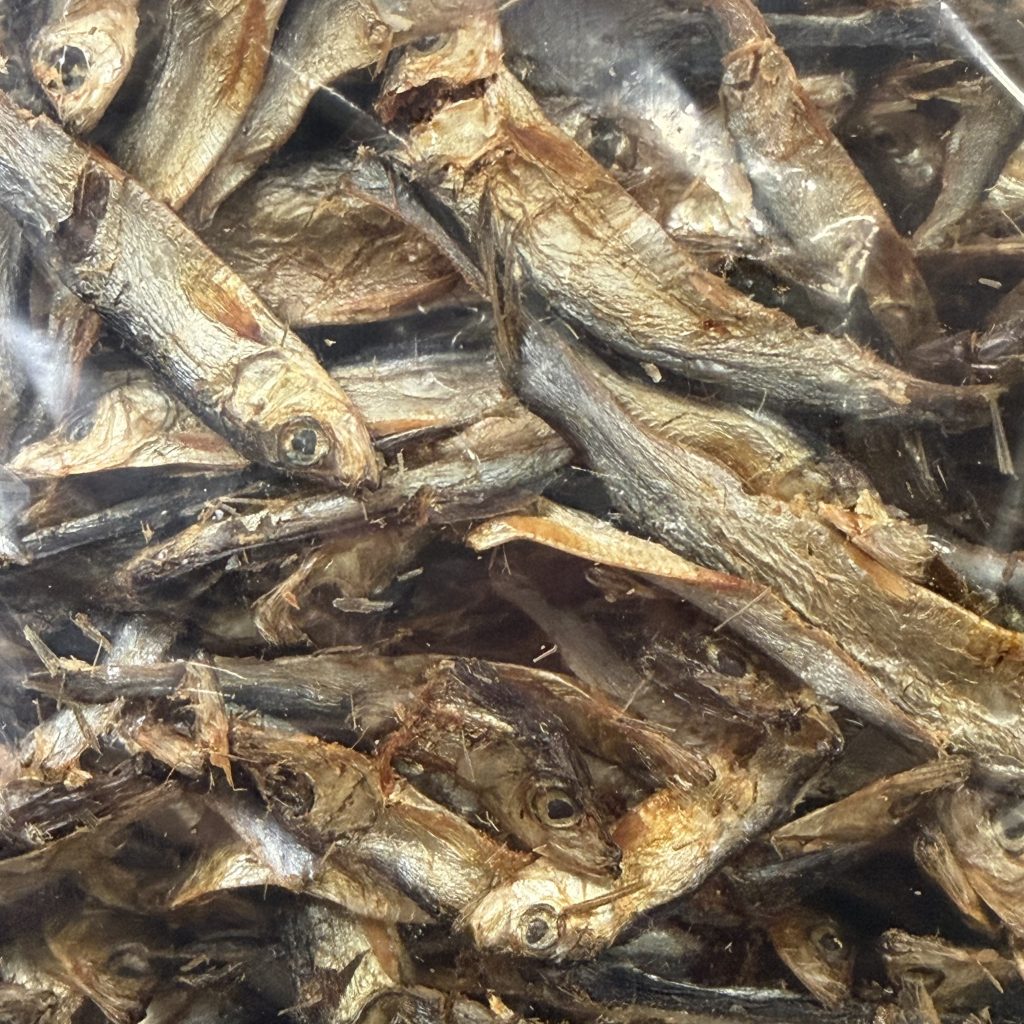
    Sprats – local pet shop, as reference for fish skin

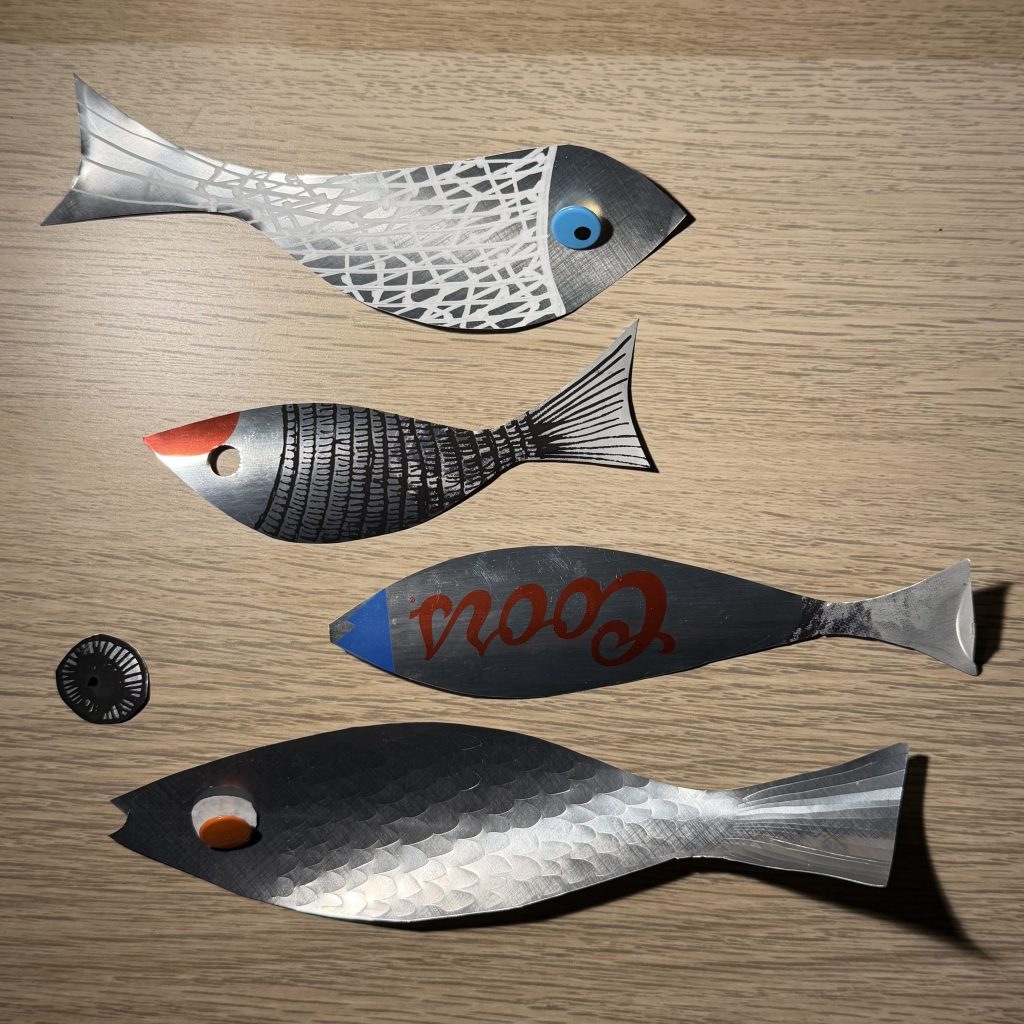
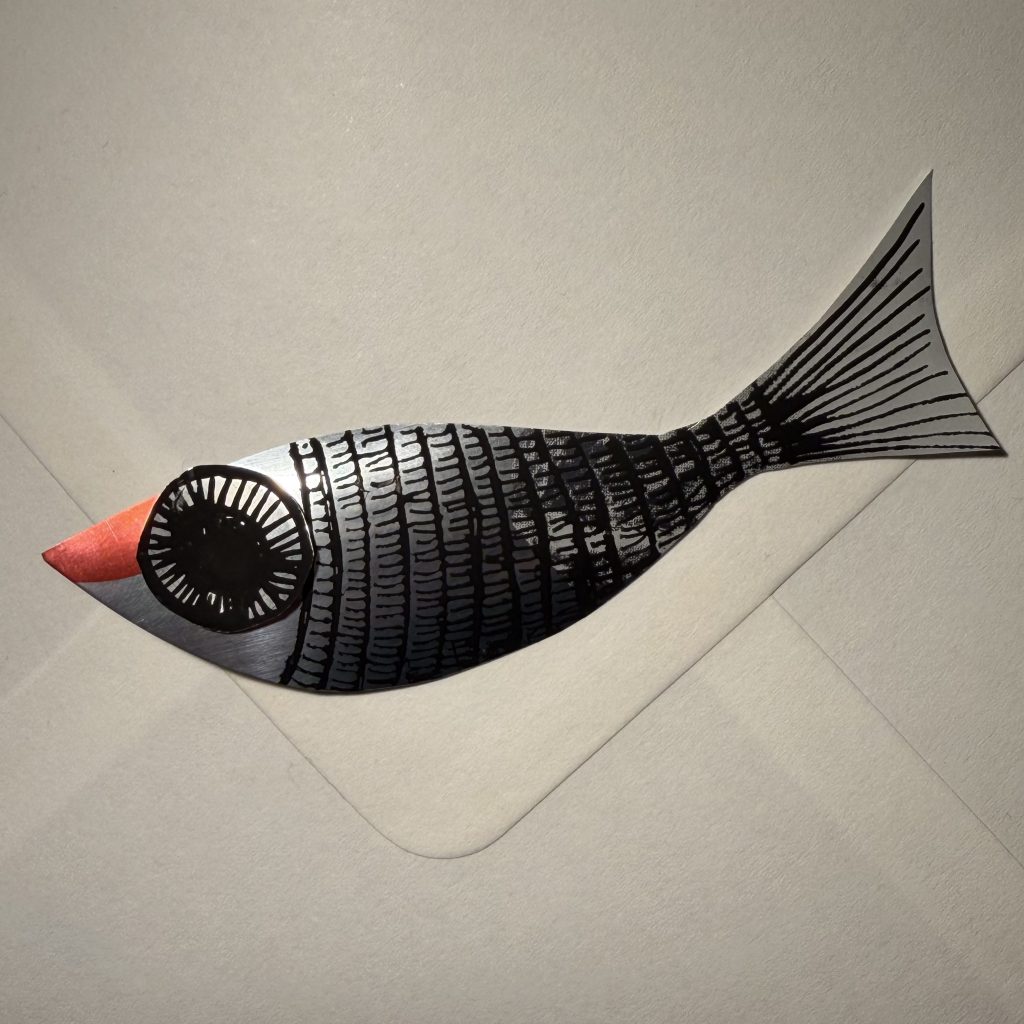
    Experimenting with cutting a set of simple outlines from a discarded beer can I found on a walk, I tried a range of decorative options including Posca pen, acrylic paint, scoring with a thick needle and piercing with a pin – looking to emulate a real fish and capture an aesthetic of hand painted by the animated ‘artist’. 

    Tin fish prototypes for Cat Painter cut from recycled beer cans. Imogen Harvey-Lewis. 2026

    I feel the tin fish have strong potential. The metal is thin and malleable. It naturally curves (having previously been a beer can) which gives it a twist and dynamism. The possibility to bend and animate is a good option. 

    We shot a short test sequence in Dragon Frame to explore the movement potential. Moving the metal fish sufficiently into 3D to both fit the aesthetic and animatic is the next challenge. 

    insert test shots here

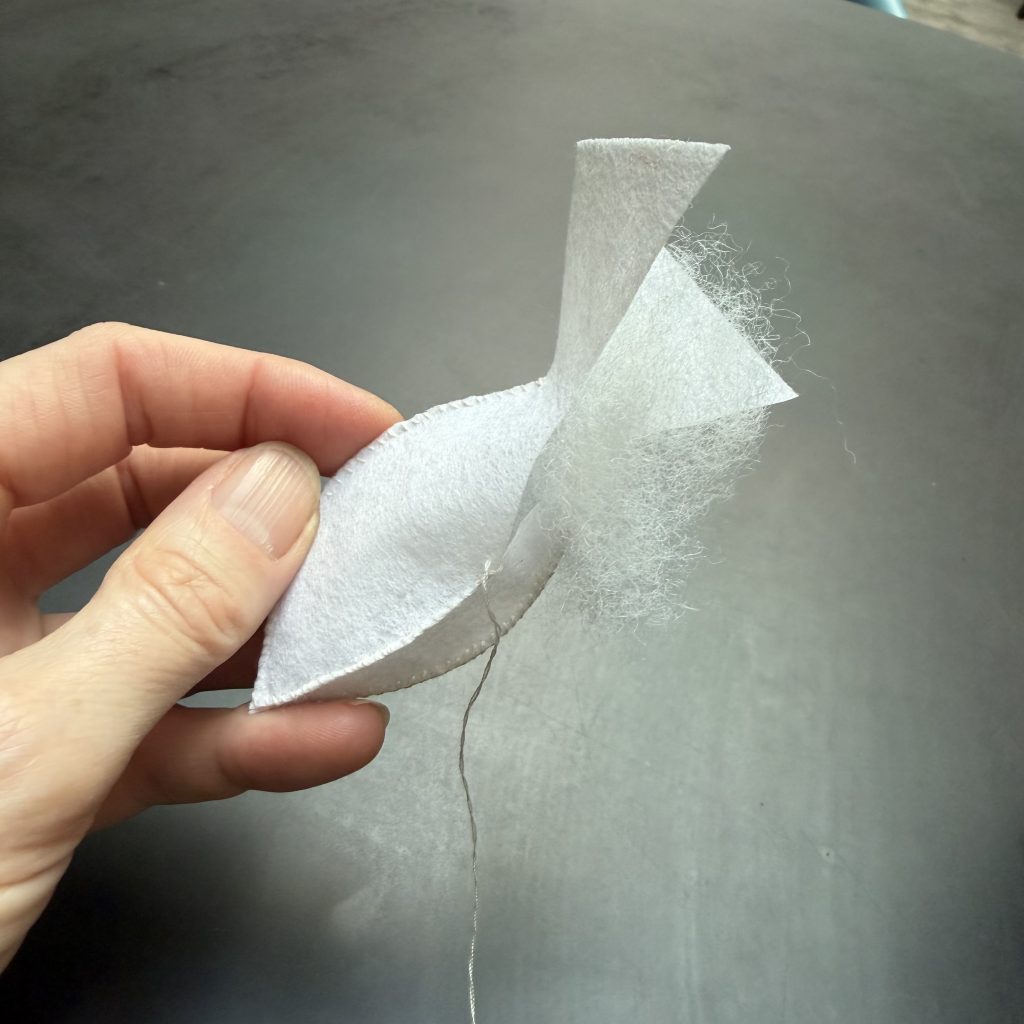
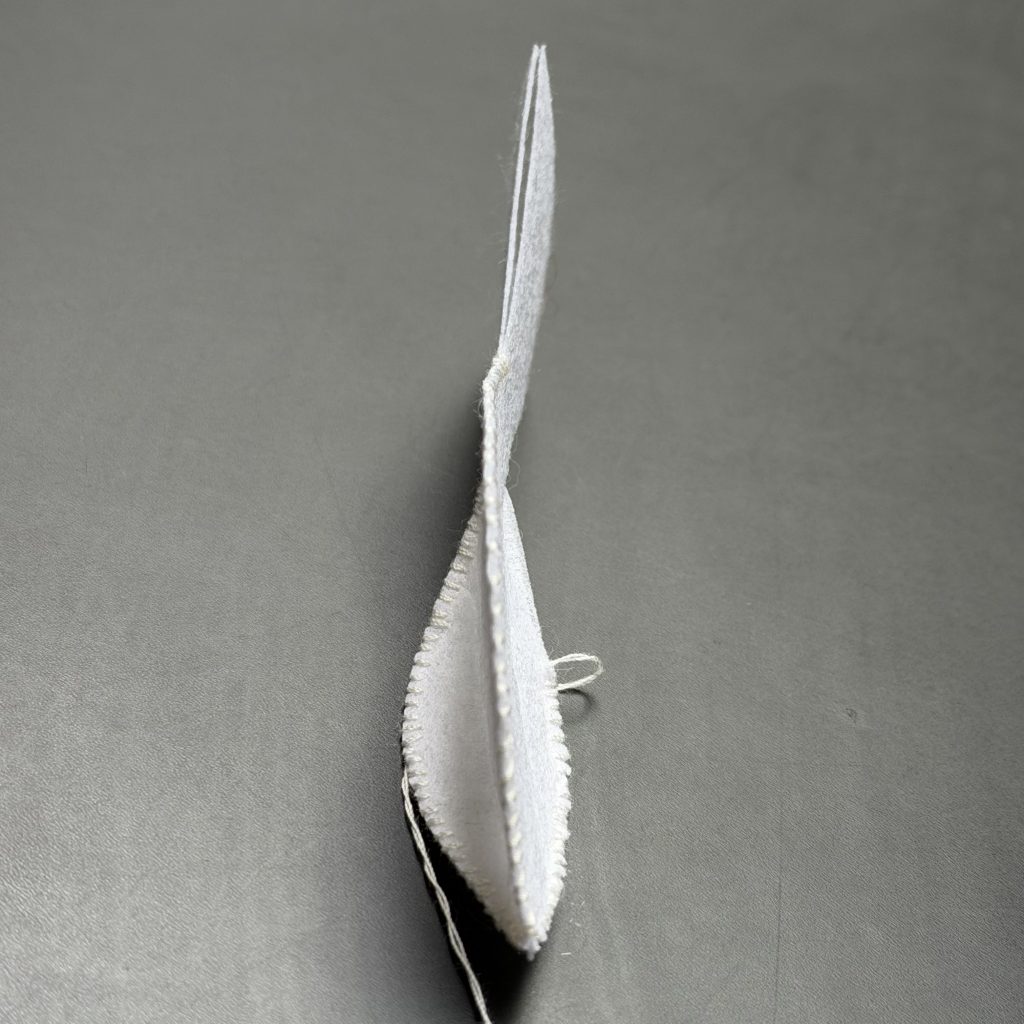
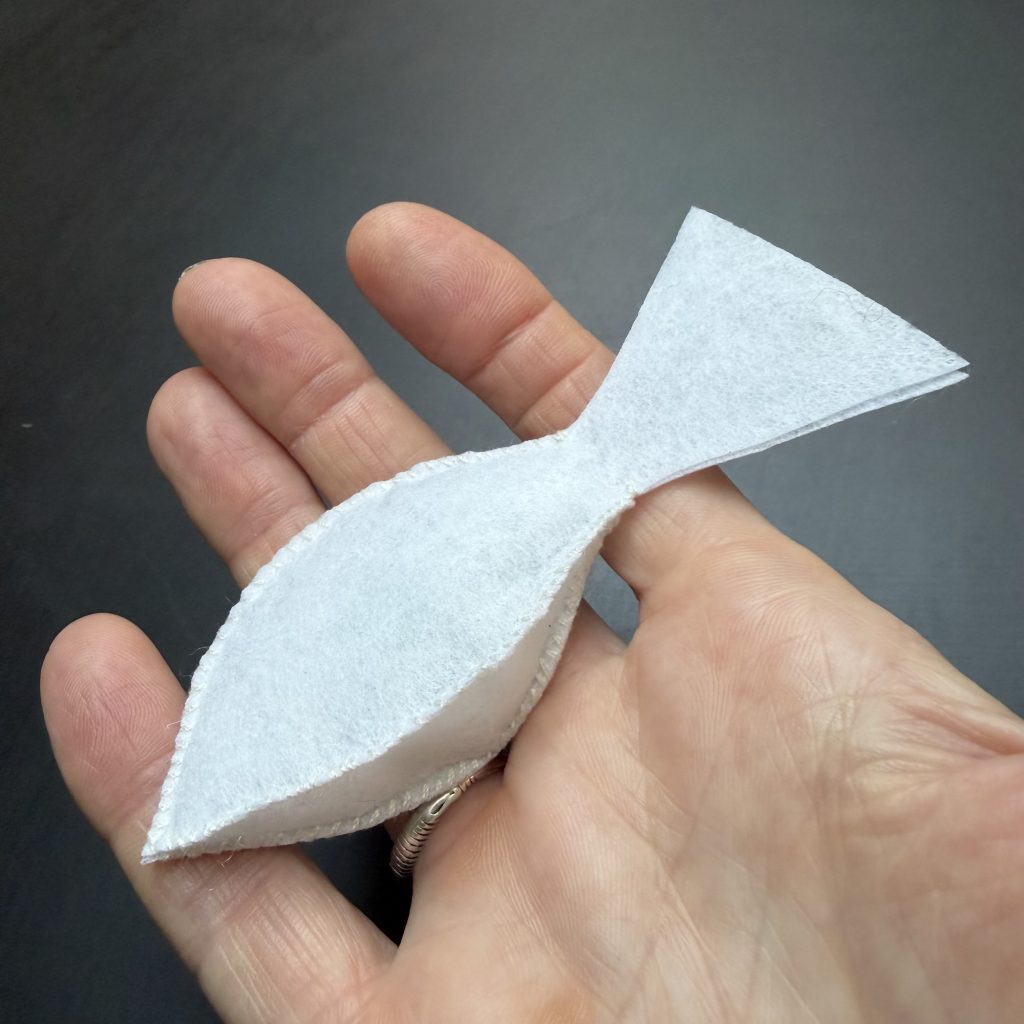
    As an alternative idea, and in align with the felt cat, I designed and made a ‘blank’ white fabric fish as an animated prop-blank for a 2D drawn animation. I have made 2 versions using Buckam fabric, both slightly filled with stuffing to give 3d appearance, one in 2 parts, one in 3 with a gusset allowing the prop/character to free stand when animating.  

    Buckram blank fish for test 2D animation shoot. Imogen Harvey-lewis. 2026

    I really look forward to learning how the 2d drawn animation is aligned with the 3D blank. I can see much potential in my own mixed media practice and my alignment with drawing and 2D.  

    As a magpie for ideas and technique which cross hatch my virtual-ideas-brain all the incite and practice this work experience is giving me feels enriching and expansive.  

    I have also been tasked to create the art to adorn the Cat’s studio. 

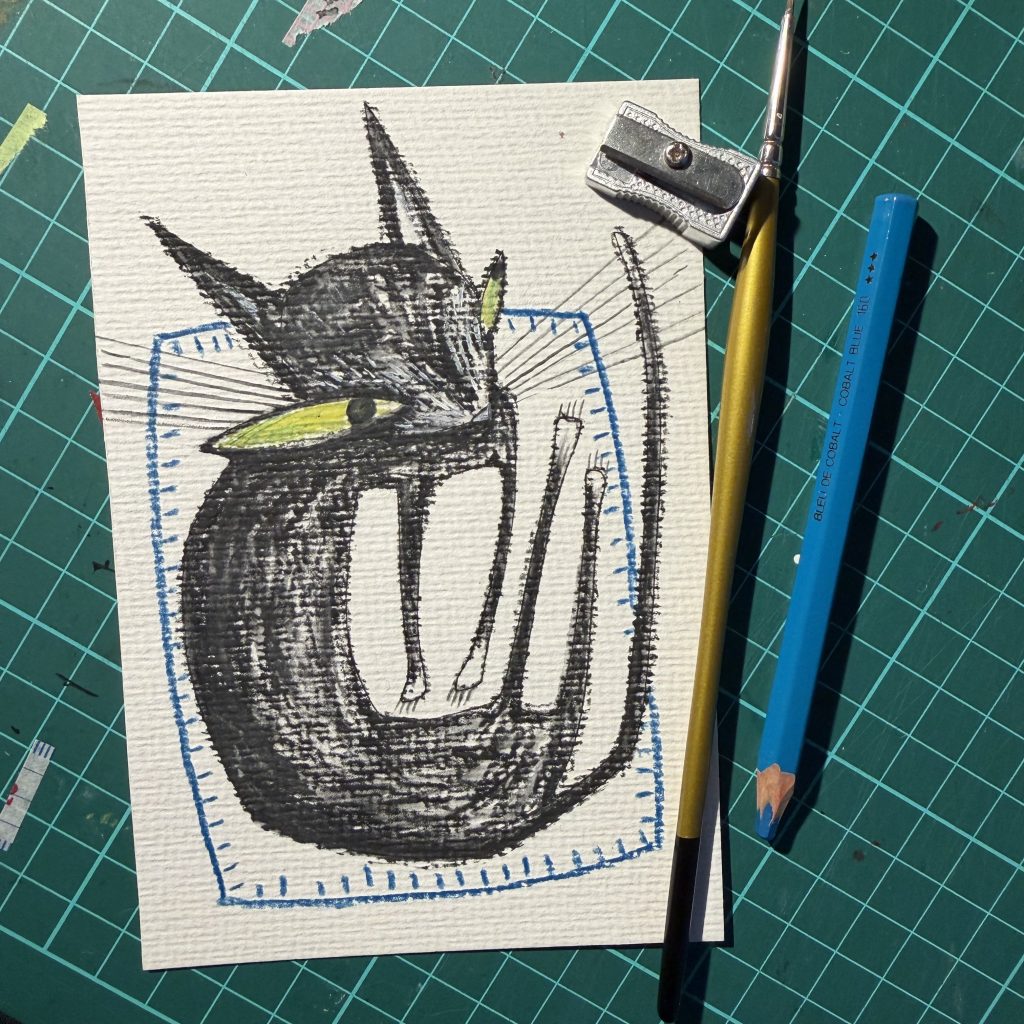
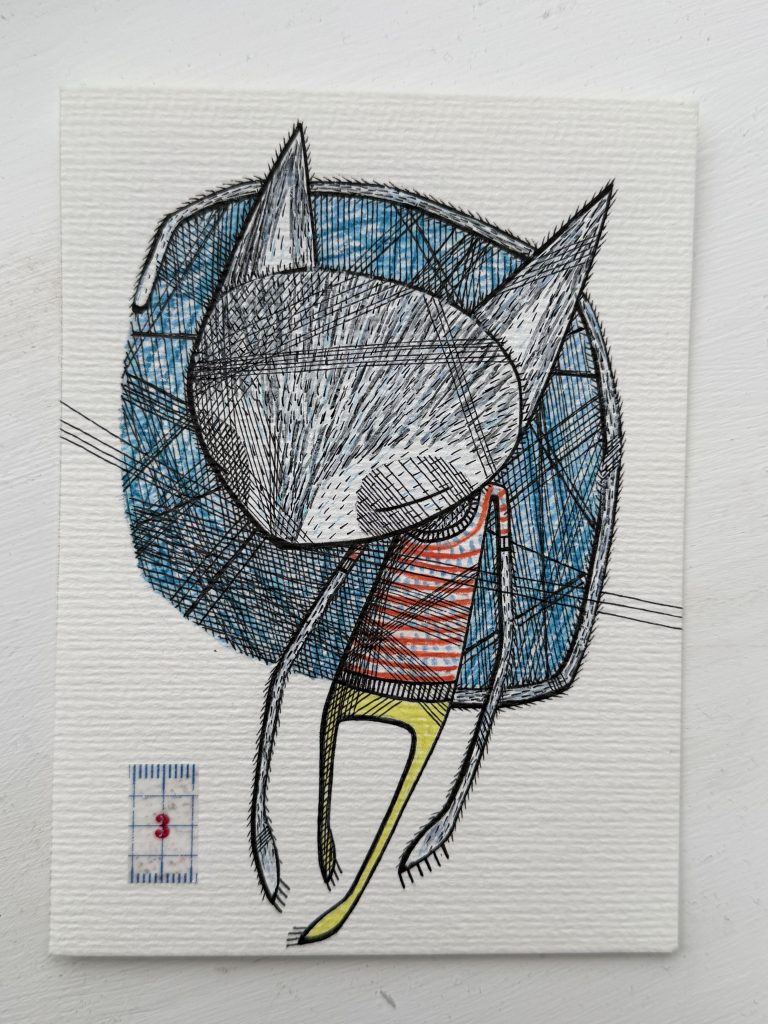
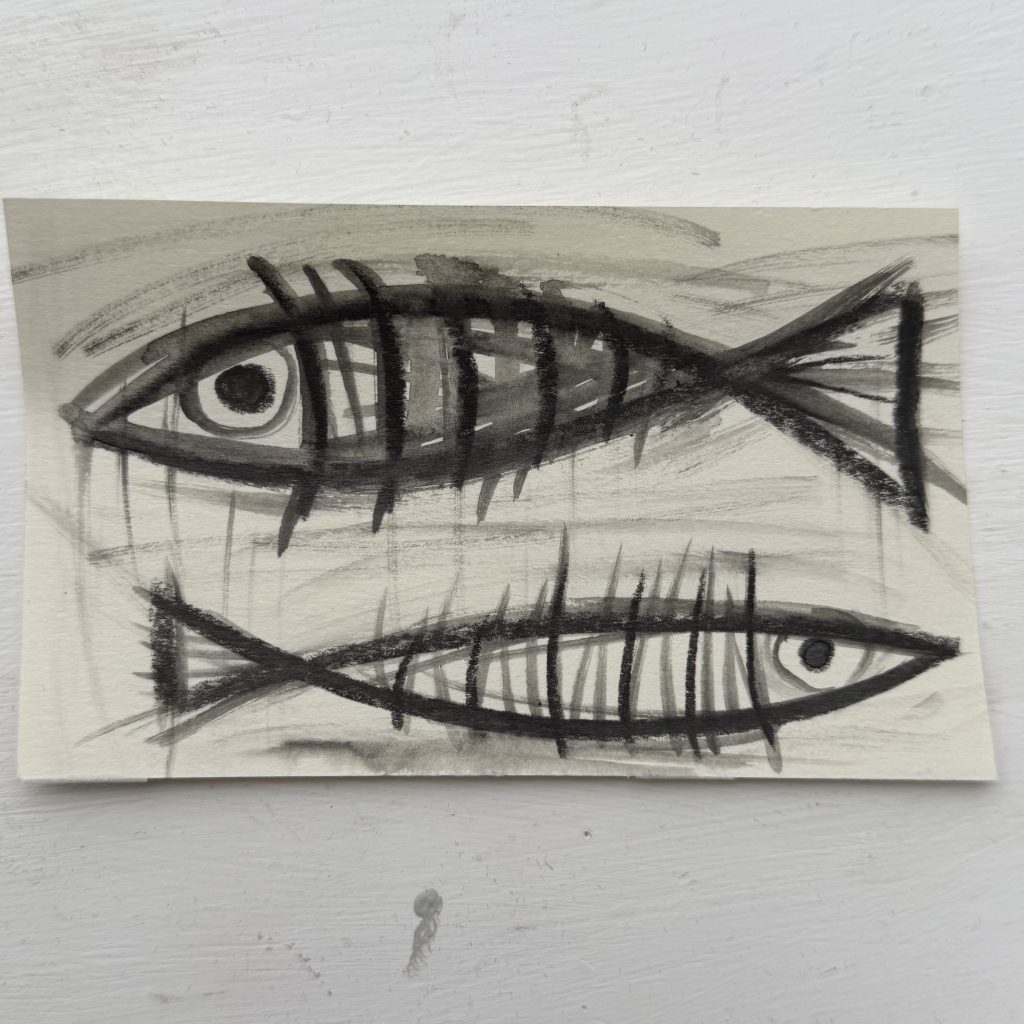
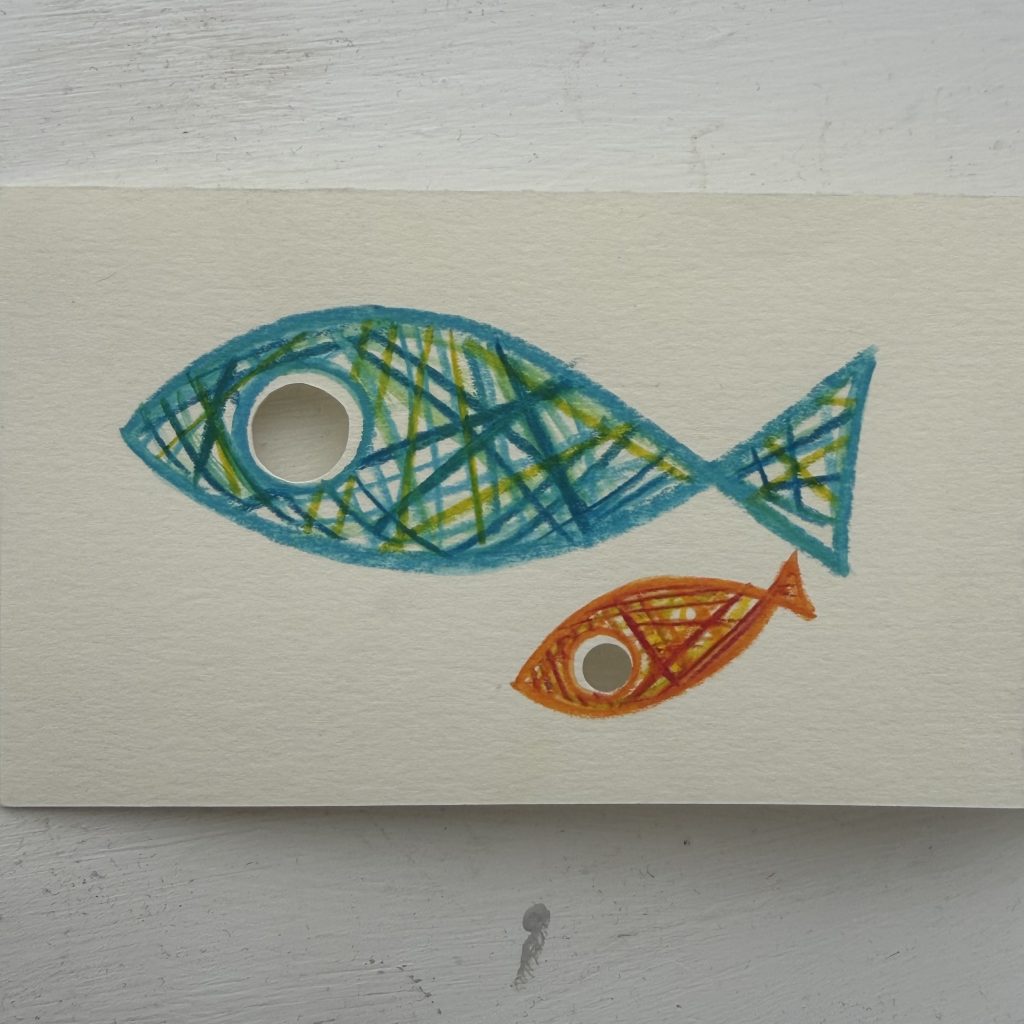
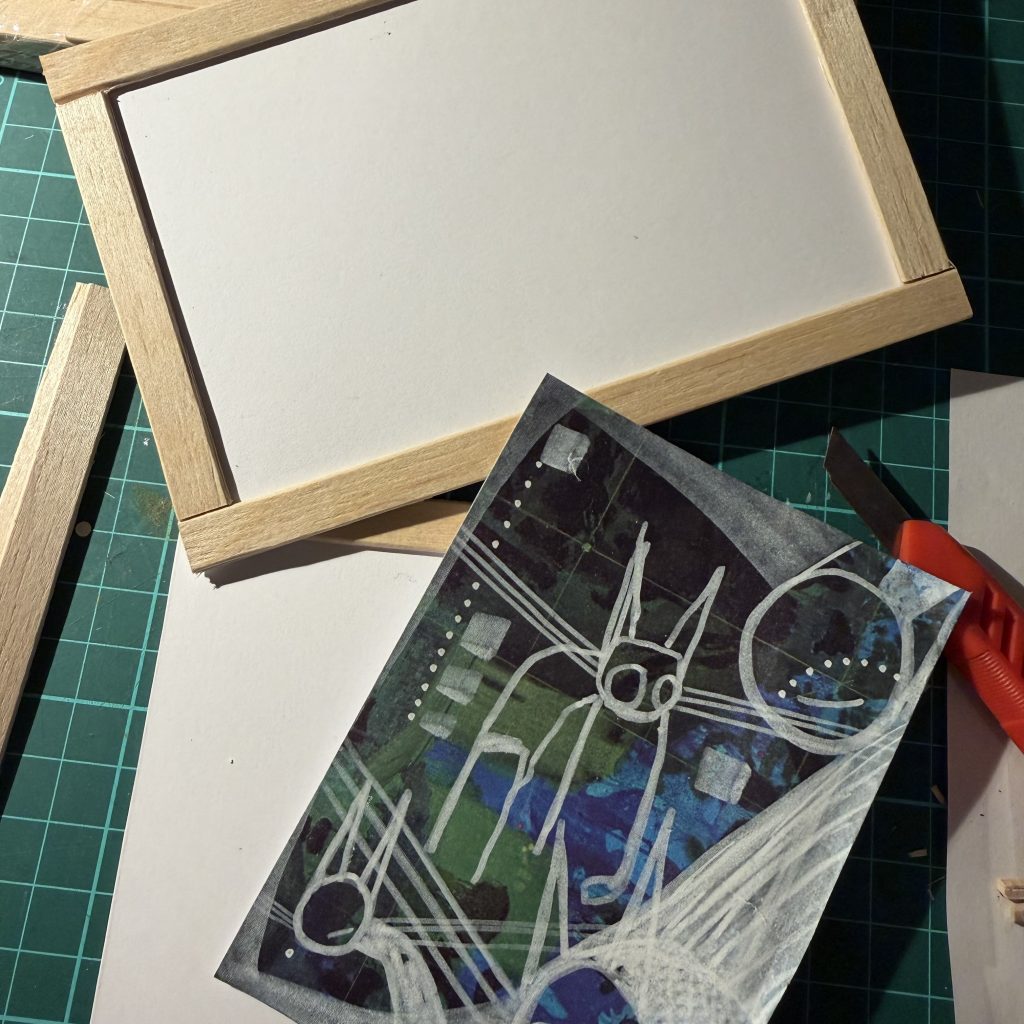
    Drawing on my illustration skills, these are miniature artworks along the feline and aquatic theme. I have tried to keep the range broad and have made plenty to give Lucia the option to choose those she feels best fits her design concept. I see that by incorporating a diversity of artworks, this creates a positive opportunity to expand the visual language of the set. 

    Experiments in Art for Cat Painter’s studio. Imogen Harvey-Lewis. 2026
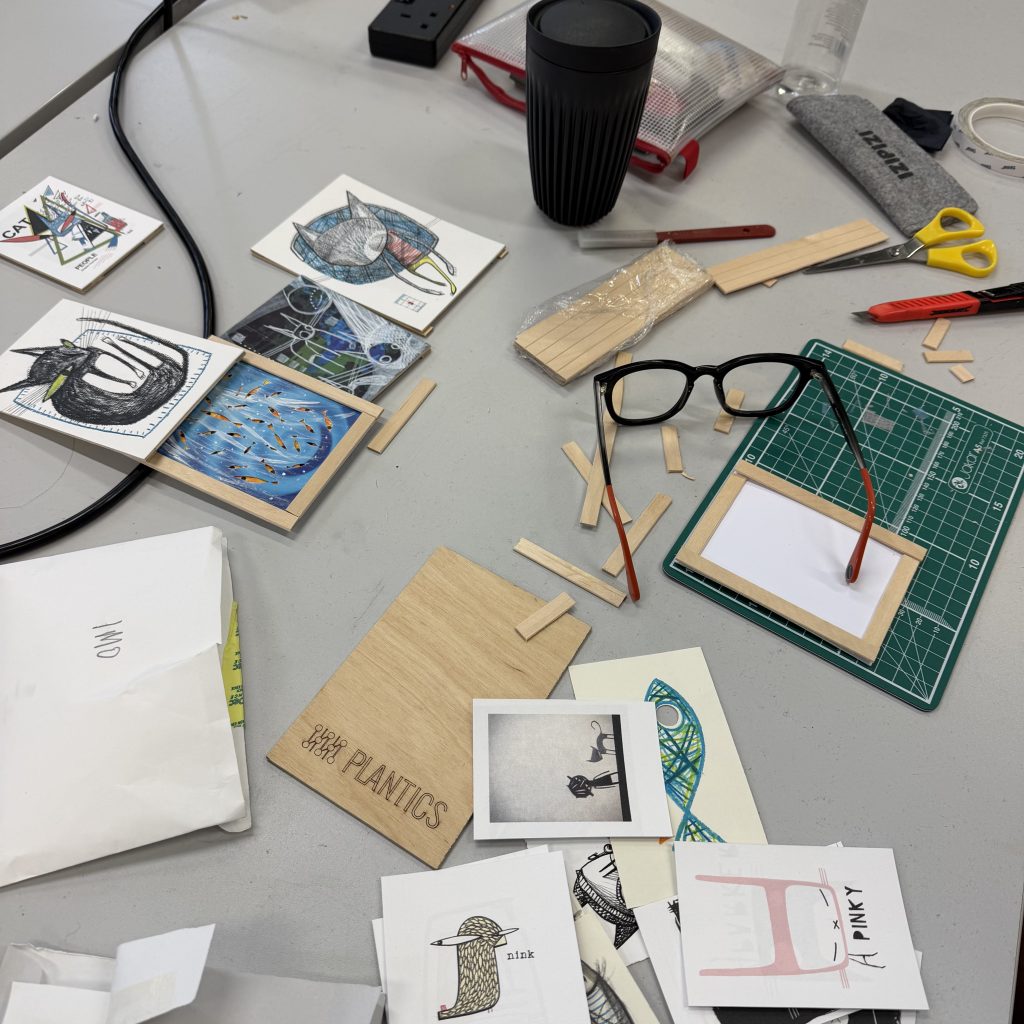
    Framing the miniatures too.

    The above artwork props where done at CSM, the images below are resourced from my portfolio. I printed, cut and mounted all. Some I framed with wood trim, some fixed up as posters for the set design.


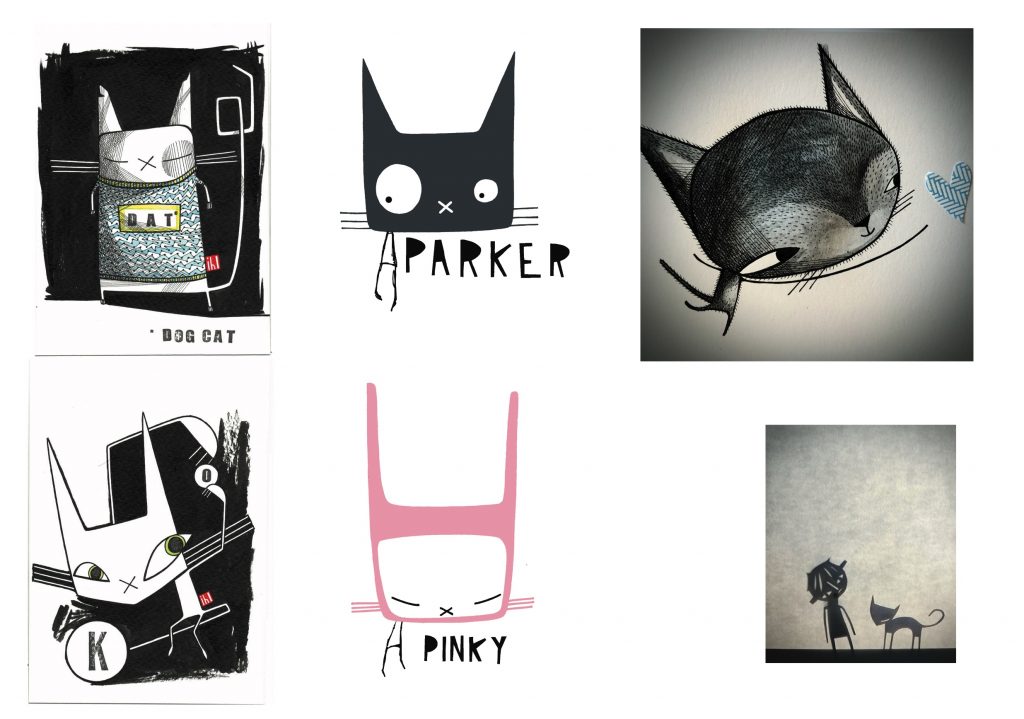
    Cat related prints. Imogen Harvey-Lewis. Sourced for Cat Painter. 2026.

    Induction to the Costume workshop. 

    As part of the research and development of the design team on Cat Painter, we enjoyed an induction to the costume department at CSM. The intention for Cat Painter, is to learn how to make tiny puppet sized costumes. We discussed the distinction between fully functioning working costumes, which move and fit as actual clothes would, and purely aesthetic visual clothing. These do not need to move independently (follow through and realism) and can be stitched on (secure and homogenised). 

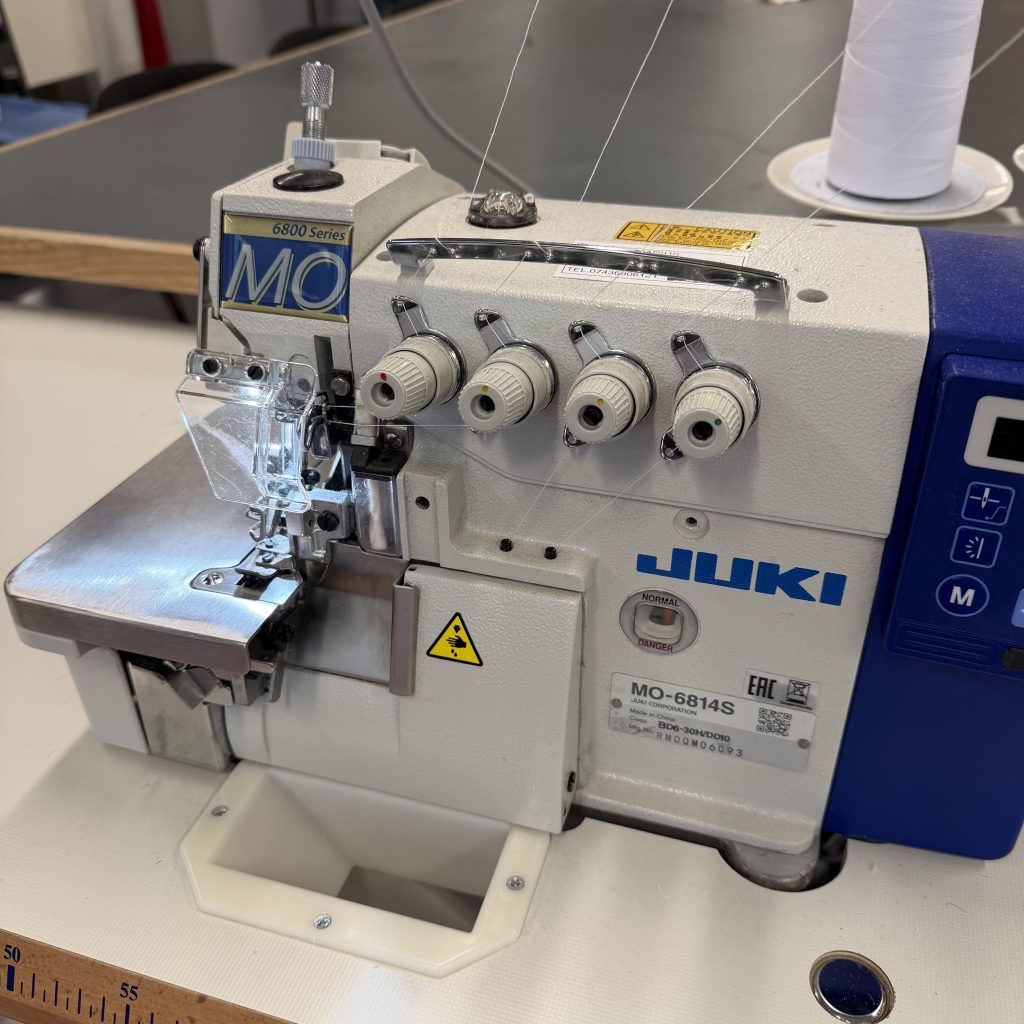
    Industrial Juki sewing machine CSM Costume Workshop

    Sarah (the brilliant technician) demonstrated a domestic Bernina sewing machines; an industrial Juki sewing machine – which is much faster and can cope with wider and thicker range of materials; an industrial and domestic overlocker – used to ‘finish’ edges without hemming; the steam iron; embroidery machine; and the knitting machine. Each machine was versatile and nuanced in what it could do. Inspiring and though provoking for animation ideas. If I was working within the animation industry, these machines would amply provide a professional working forum to tackle the majority of fabric based construction tasks.

    Costumes for stop-motion will tend to be small scale, so domestic machines will be the most appropriate, but all dependable on ideas, scale and the project in hand. I learnt that different fabrics move, hang, flow, attach, sit, crease, compress, stretch, etc., in a unique way.

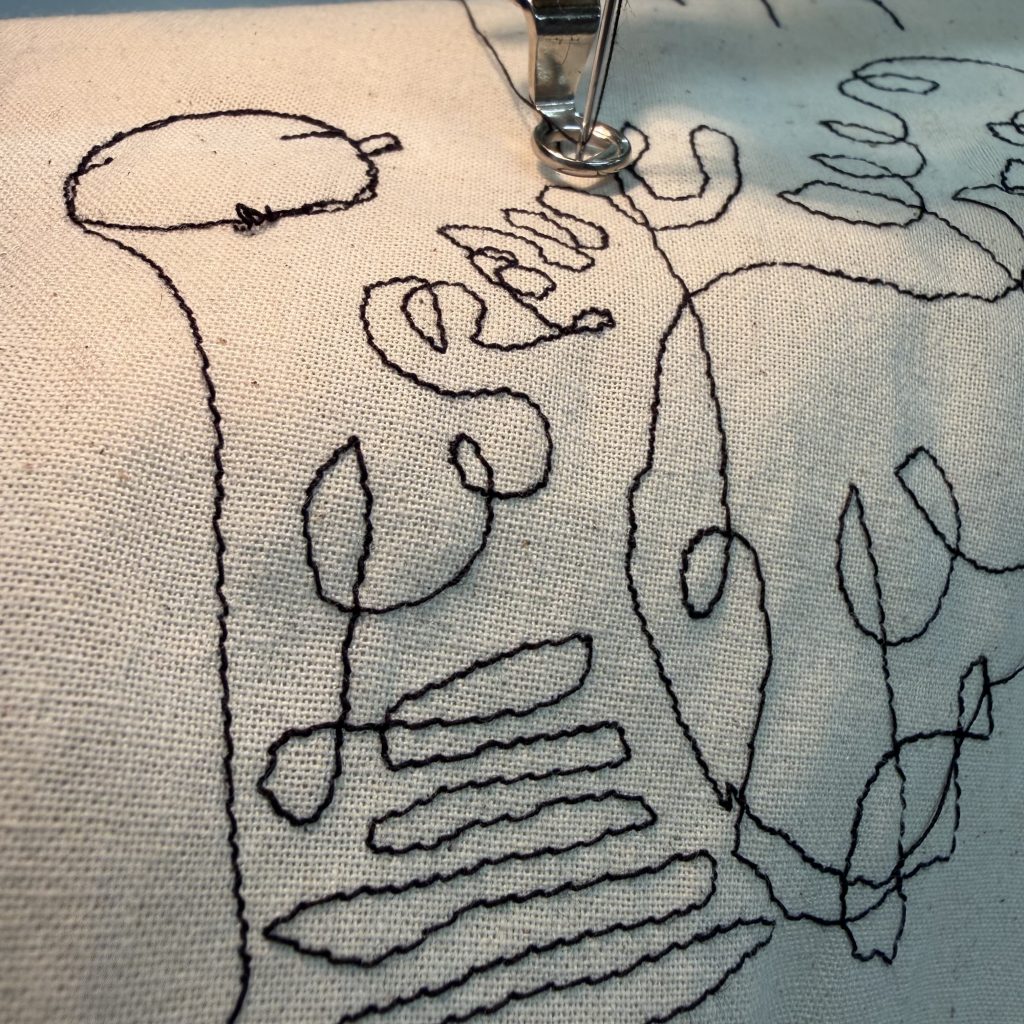
    Experimentation for Cat Painter costumes. Embriodery head on domestic sewing machine.

    We experimented on squares of calico. Different stich sizes, flows of line and reverse stitch. I enjoyed this. Sewing machines, as opposed to embroidery and applique, draw in continuous lines. There’s a speed and a flow which to some extent dictates a fluidity in the marks and patterns you are making. 

    Lots of ideas have come to me as a result of the costume workshop. In technique – Paper stitching; bookbinding simple animated flip books; suspended by a thread characters in stop motion; continuous line ‘drawing’ in stiches. In conceptual story lines – sewing things together; ‘fixing’ things (badly); repair; a stich in time; ‘Fabric’ – constituent parts of a whole….and more. 

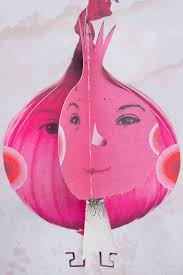
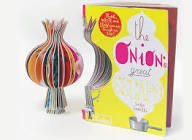
    Coincidently I came upon an image by Sara Fanelli Onion Head from The Onion’s Great Escape, published Phaidon 2012, the same day we did the costume induction. It is a paper stitched fold out head simply animated with a wink. I love it and will work up a short sequence in response. 

    The Onion’s Great Escape. Sara Fanelli. 2012.

    Reflections

    My reflections on my work experience on Cat Painter is that preparation is the key. A clear plan is essential to keep all the preparatory strands on point and to avoid unnecessary side tracks. Attention to detail is important but should not stifle the workflow. Keeping the momentum buoyant and inspiring makes for an energetic and enjoyable process.  Group work relies on individuals committing work time to coincide and complement each other. Precious time can easily be lost in waiting for other peoples availability.

    Balancing aesthetics with technical necessity has been a steep learning curve. How things look and how things work on set do not necessarily conform. In illustration, this is not such a dilemma. In animation however, which is a careful balance of the two, practicality comes first. The set, props and puppets must move, attach, animate, secure, light etc first and foremost. It is film making – a technical process. How things look  (I’m learning) comes a close second. One supports the other, but an animation which doesn’t animate, is not an animation.

    Bringing this understanding into my own stop-motion animation practice, I am determined to expand my working with different materials. Setting up multiple short sequences and shooting a few seconds, enough to feel the challenge, is invaluable ‘homework’ and will go to creating a bank of test shots for future reference and transference of skills.

    Coming to a new idea raw can be very exciting to develop, however having the experience of various methods and materials already tested to some degree makes for a more confident pitch.

    Supporting and being part of a team of animators has been an invaluable insight into the many variables and considerations which go into preparing for a short stop-motion film. Joining the team pre-shoot has meant my exposure to actually animating has been limited. I would have appreciated more time to support and learn during the animation process.

    I will be keeping in touch with the progress of Cat Painter over the next couple of months and if time permits lend a hand and learn as much as I can for Lucia and her team.